
ScalingAR: Scaling Confidence for Autoregressive Image Generation
ZODA-contributed work ScalingAR was accepted to ICML 2026. It proposes a test-time scaling framework for autoregressive image generation that leverages the model’s own confidence signals to improve generation quality and efficiency.
Imagine this scene: a sheep is quietly standing on a grassy field, eating grass. But as the generation process continues, its wool begins to expand, floating upward like cotton clouds.
Prompts like this are often referred to in research as “impossible prompts.” They are used to test whether a model can still follow instructions faithfully in scenarios that violate common sense.
Most autoregressive image generation models begin to waver at this stage. They may remain stable at first, but as generation progresses, the image becomes increasingly likely to drift away from the original description.
This is not an isolated mistake by a single model. Models that generate images under the next-token prediction (NTP) paradigm commonly show similar instability during generation.
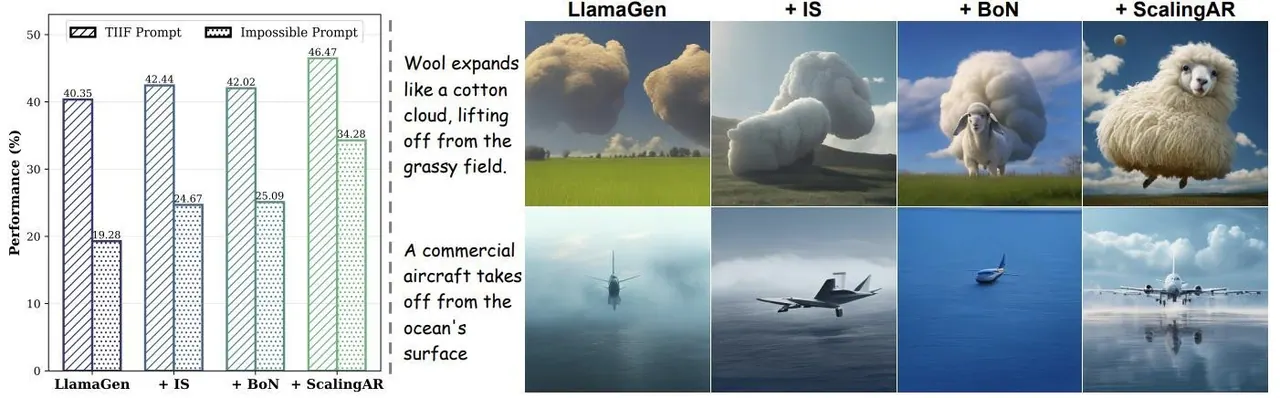
To address this issue, the paper ScalingAR: Scaling Confidence for Autoregressive Image Generation offers a different answer.
The paper has been accepted to ICML 2026. It was jointly completed by HKUST (GZ), HKUST, UNC-Chapel Hill, ZODA, CityUHK, and Fudan University, with ZODA participating as a collaborative research contributor.
As a community focused on data, evaluation, and open-source collaboration, ZODA is interested not only in high-quality datasets themselves, but also in advancing mechanisms that improve the stability, controllability, and inference efficiency of generative models. We are also interested in whether lighter-weight approaches can improve the stability and efficiency of open-source AR image generation models.
ScalingAR provides a clear example: quality fluctuations in autoregressive image generation do not necessarily have to be solved by larger models or external reward models. Instead, we can read the key signals that the model is already revealing during generation.
1. Why can’t we simply copy the experience of LLMs?
ScalingAR first explains one point: images are not text. Test-time scaling for autoregressive image generation is not a simple replication of LLM methods.
The paper identifies three unavoidable differences.
The first is holism. If the last 20% of a text passage is removed, the remaining part is often still readable. But if an image token stream is cut off midway, what remains is usually an unusable image.
The second is objective ambiguity. Math problems have standard answers, and code can be checked with unit tests. Image generation does not. The “correct image” for a prompt is a distribution, not a single point.
The third is early signal scarcity. Partially decoded image tokens are visually unstable. Judging too early is risky, while waiting until the image is fully decoded removes the point of scaling.
This is why existing paradigms, such as TTS-VAR and Best-of-N, typically rely on frequent partial decoding together with external reward models for scoring. They work, but the cost is high and the speed is slow.
2. An overlooked internal signal: the model already exposes failure trajectories
This is where the core contribution of the paper begins.
ScalingAR is the first test-time scaling framework designed specifically for NTP-based autoregressive image generation. It is also the first to introduce token entropy into visual autoregressive generation as a source of model confidence signals.
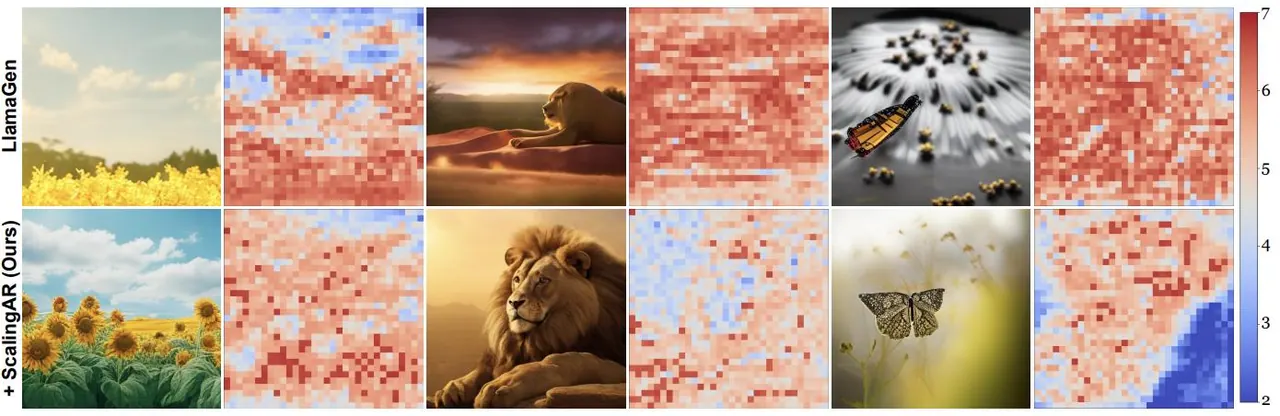
The key insight comes from a phenomenon already familiar in the language model field. Researchers have long observed that high-entropy tokens are often associated with higher error rates, a pattern that has been repeatedly validated in language generation tasks.
But in autoregressive image generation, this signal had not previously been used in a systematic way.
The core judgment made by the ScalingAR research team is this: instead of introducing a new external judge, return to the model itself and use token entropy from the model’s own output distribution to determine whether the current generation trajectory is still worth continuing.
The paper further identifies two failure modes.
The first is local instability: certain tokens show abnormally high entropy, indicating that the model is wavering at that position. This instability then propagates along the autoregressive chain.
The second is semantic drift: as generation steps proceed, the influence of the prompt is gradually overwhelmed by the autoregressive prior. The image begins to move in the direction the model is more familiar with, rather than the direction required by the prompt.
3. A two-level framework: diagnosing confidence first, then regulating generation strategy
Based on these two failure modes, ScalingAR designs a two-level framework.
It does not retrain the model. It does not introduce a new reward model. It only reads the model’s own output distribution during inference and then makes decisions.
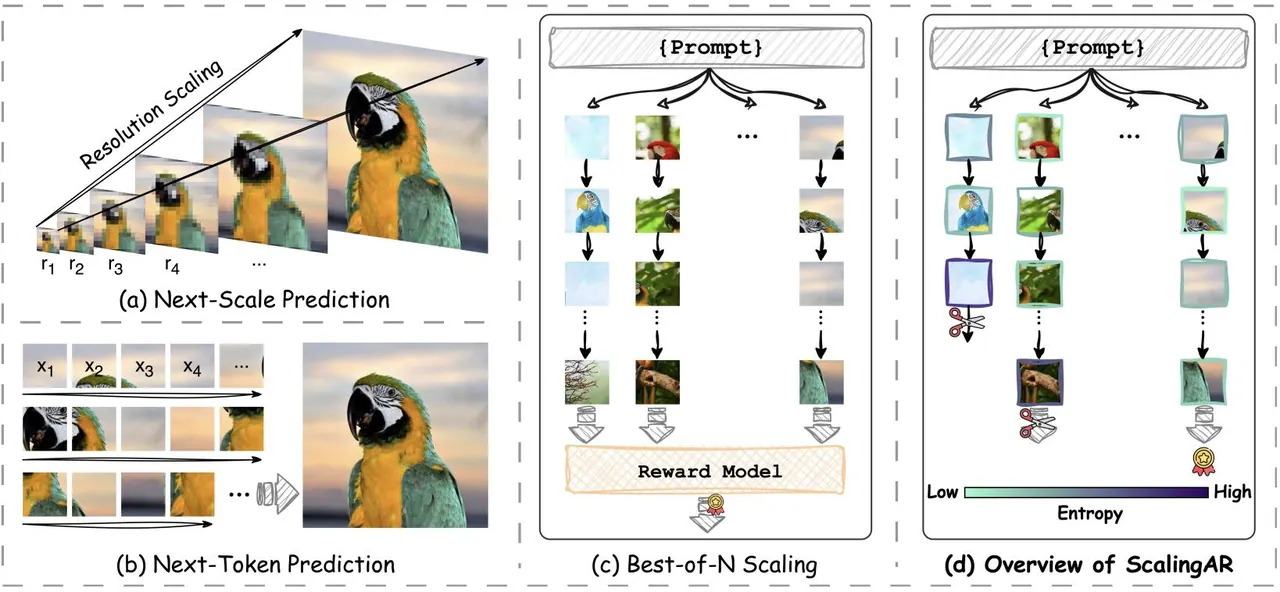
The first level is the Profile Level, which answers one question: is this generation trajectory currently healthy?
It characterizes the current state through two complementary channels.
The intrinsic channel focuses on the model’s own stability. It combines token-level confidence, derived from entropy and the top-1/top-2 probability gap and smoothed with an exponential moving average (EMA), with worst-block stability, which refers to the entropy level of the least stable local block. Following the weakest-link principle, this ensures that abnormalities in any critical region are not hidden by a global average.
The conditional channel measures whether the prompt is still controlling the model. Specifically, it computes the KL divergence between the conditional and unconditional distributions to capture semantic drift.
The two channels are then fused into a unified confidence state.
The second level is the Policy Level, which takes action based on the confidence state.
It does two things.
First, adaptive termination: in each batch of generation, it dynamically sets thresholds using quantiles, pruning only the relatively worst trajectories. It also includes a recovery window to avoid mistakenly killing valid samples during short-term fluctuations.
Second, guidance scheduling: it dynamically adjusts the CFG, or classifier-free guidance, coefficient. When semantic drift or local instability becomes stronger, it increases guidance. When generation has stabilized and recovered, it relaxes guidance to leave room for diversity.
The entire design requires no retraining. It only takes effect during inference, does not rely on any external reward model, does not modify the input image, and does not change model weights.
In essence, it is a pluggable inference-time regulator that can be attached to existing autoregressive image generation models.
4. Results: fewer tokens, better generation quality
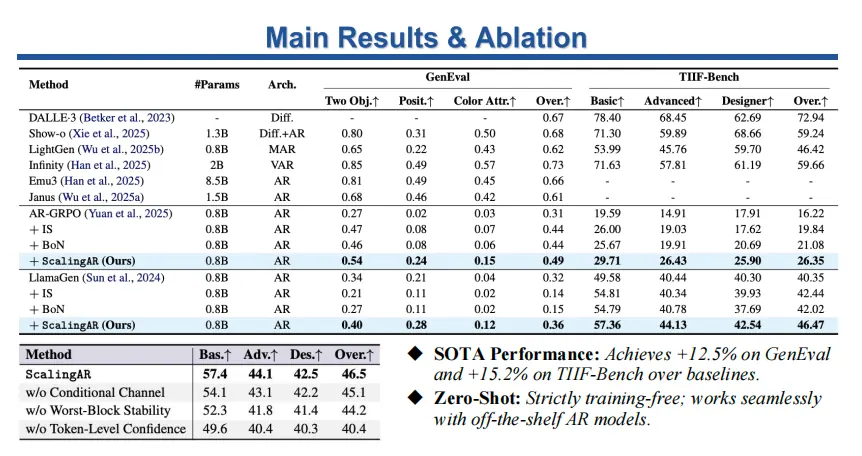
In the experiments, ScalingAR was applied to four different autoregressive image generation models: LlamaGen, AR-GRPO, SimpleAR, and Janus-Pro.
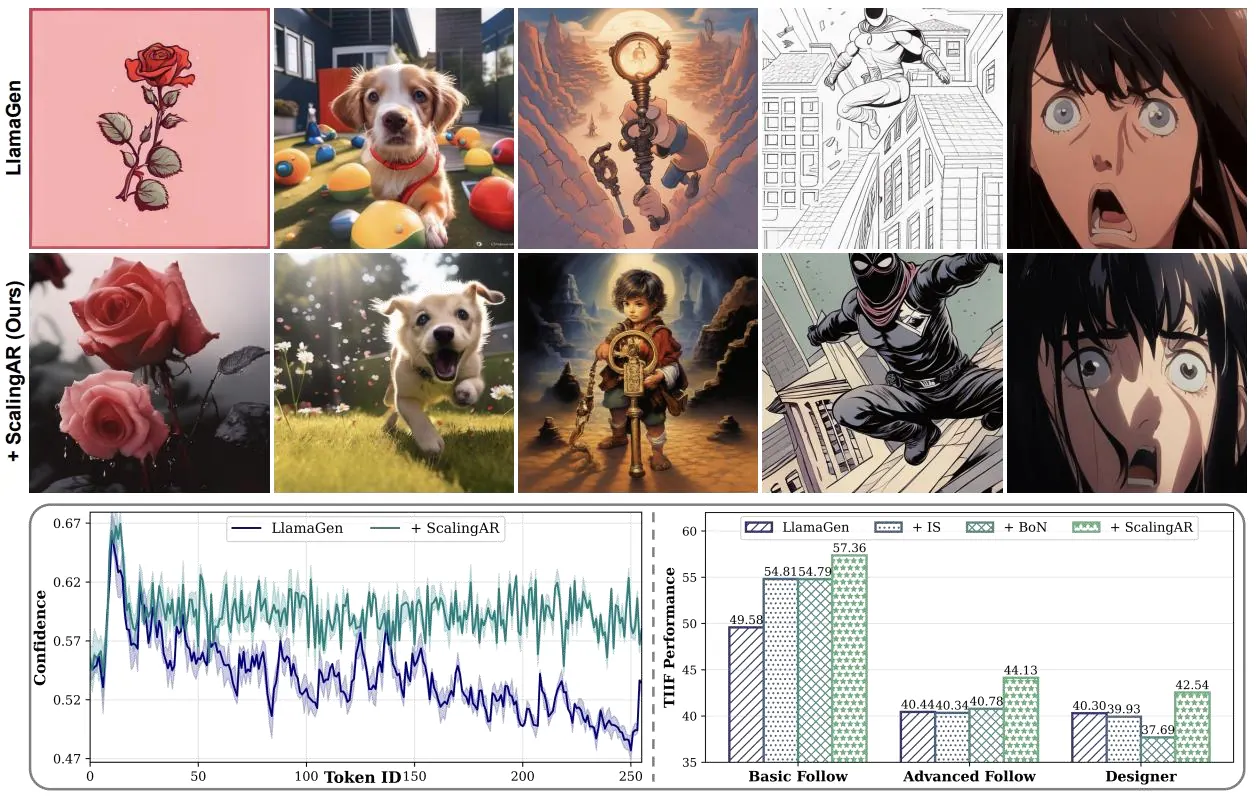
On LlamaGen, ScalingAR brings a 12.5% improvement on GenEval and a 15.2% improvement on TIIF-Bench, outperforming two classic baselines: Importance Sampling and Best-of-N.
When facing challenging scenarios such as impossible prompts, performance degradation is reduced by 26% compared with the baseline model.
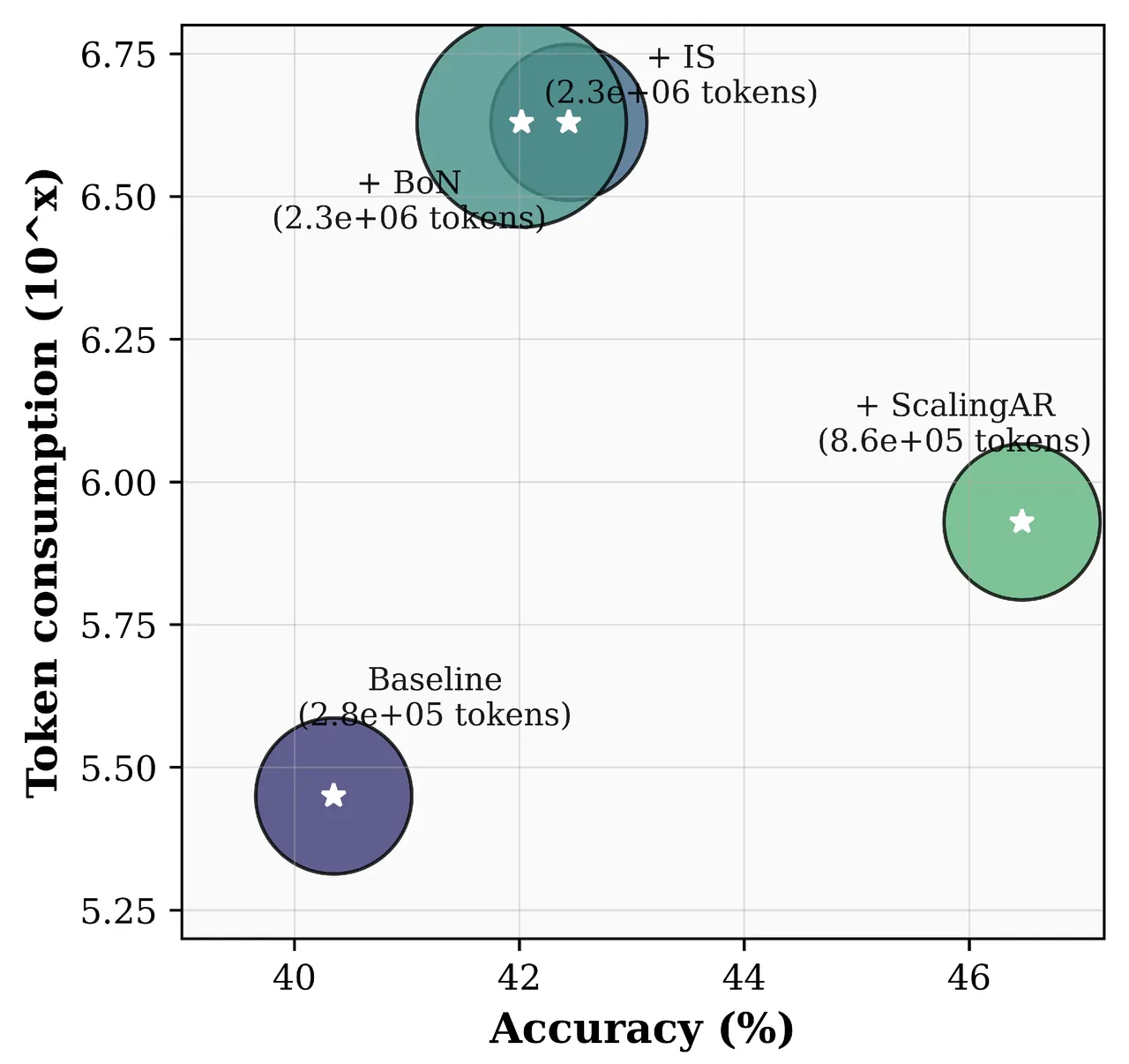
The efficiency comparison is even more direct:
Best-of-N, at N=8, takes about 218 seconds in total, requires around 39 TFLOPs, and reaches 48.7 GB peak memory.
ScalingAR, also at N=8, takes about 69 seconds in total, requires 4.23 TFLOPs, and reaches 18.2 GB peak memory.
Visual token consumption is reduced by 62% compared with BoN, and inference speed improves by about 3.1x.
It is worth noting that the same set of hyperparameters works directly across the four autoregressive models: LlamaGen, AR-GRPO, SimpleAR, and Janus-Pro. No model-specific retuning is required.
This suggests that what ScalingAR captures is not a special case of one model, but a more general pattern in autoregressive image generation.
By allowing the model to abandon trajectories that are destined to fail earlier in the generation process and concentrate computation on directions that still have promise, ScalingAR achieves higher quality with fewer visual tokens compared with traditional TTS baselines.
5. ZODA’s view: make the model’s internal signals the starting point for improvement
ScalingAR reveals an easily overlooked possibility.
Improving generation quality does not necessarily depend on larger models, more data, or more complex external reward models. It can also come from a more refined reading of the model’s internal signals.
The model itself is already revealing a large amount of information at every generation step. If we can read these signals more precisely, we may be able to push the capabilities of existing models further.
ScalingAR does not change the model itself. Instead, it gives the model another way to judge itself during generation: continuously checking whether the current trajectory is still healthy through token entropy and conditional KL divergence.
This simple shift may become a starting point for the next stage of progress in open-source autoregressive image generation.
This is exactly the direction ZODA continues to focus on: providing a lightweight path to improving the stability and efficiency of open-source AR image generation models. It is also consistent with ZODA’s broader work on high-quality data, trustworthy evaluation, and efficient methods.
6. Conclusion: the next step for autoregressive image generation is learning to judge itself
ScalingAR points not to a simple sampling trick, but to a shift in perspective.
Autoregressive image generation models should not only be judged externally after generation is complete. They can also continuously read their own state during generation and, when necessary, abandon trajectories that are headed toward failure.
For open-source models, beyond model scale and training data, how a model identifies low-confidence trajectories during inference is also a key factor affecting stability.
Returning to the sheep standing on the grass at the beginning: if an autoregressive image generation model can sense at every step whether it is beginning to waver, it may not let the sheep’s wool expand into an uncontrolled cotton cloud.
When we ask a model to generate an image of a complex scene, the key question is not only whether the final image looks good. It is also whether the model can judge, at every step of generation, whether it is still moving in the right direction.
This is the value of ScalingAR: pushing the capability boundary of autoregressive image generation toward something more measurable, more interpretable, and more collaborative.
Follow ZODA for more updates on AI data, model evaluation, and the open research ecosystem. We also look forward to working with more researchers, developers, and industry partners to continue exploring the boundaries of generative models’ ability to assess themselves, and to help build a more open and transparent AI research ecosystem.